Save Money on Potting Soil and Planters in Your Garden

There’s no doubt that growing your own veggies can save money at the grocery store. But with flowers the costs of potting soil, hanging baskets, and planters can still mount up. If you’re like me you look for ways to not spend. I’d rather use my cash to try this year’s selection of new cultivars. This post is about a couple of ways to save money with container gardening. 

First, look for containers to repurpose as pots. Many types of containers will work as long as it holds soil and allows the excess water to drain out. Some containers can be whimsical like high-heeled shoes, an old watering can or a beautiful basket. 

You can save money on potting soil a couple of ways. If your plant didn’t have a disease the previous season, you can freshen the soil by mixing half of it with new potting soil. With large planters I’ve placed bricks at the bottom of the planter and used a smaller pot on top of the bricks so as not to have to fill the whole large planter with potting soil. I’ve also read that using water bottles at the bottom of large containers reduces the amount of soil and lightens the weight of the container for ease of moving it around. I did try this last season with mixed results. That pot actually kept being blown over in light winds, and also seemed to require watering more frequently. Possibly I used too many water bottles, making it too light and allowing the water to drain out too fast.

Lastly, I love to hunt for bargains at estate sales. You can get beautiful planters for next to nothing. And don’t be afraid to buy a ceramic or porcelain container. At estate sales you can sometimes find Chinese planters and fish bowls. These can be used on your deck, patio, or in the garden by adding drainage holes.
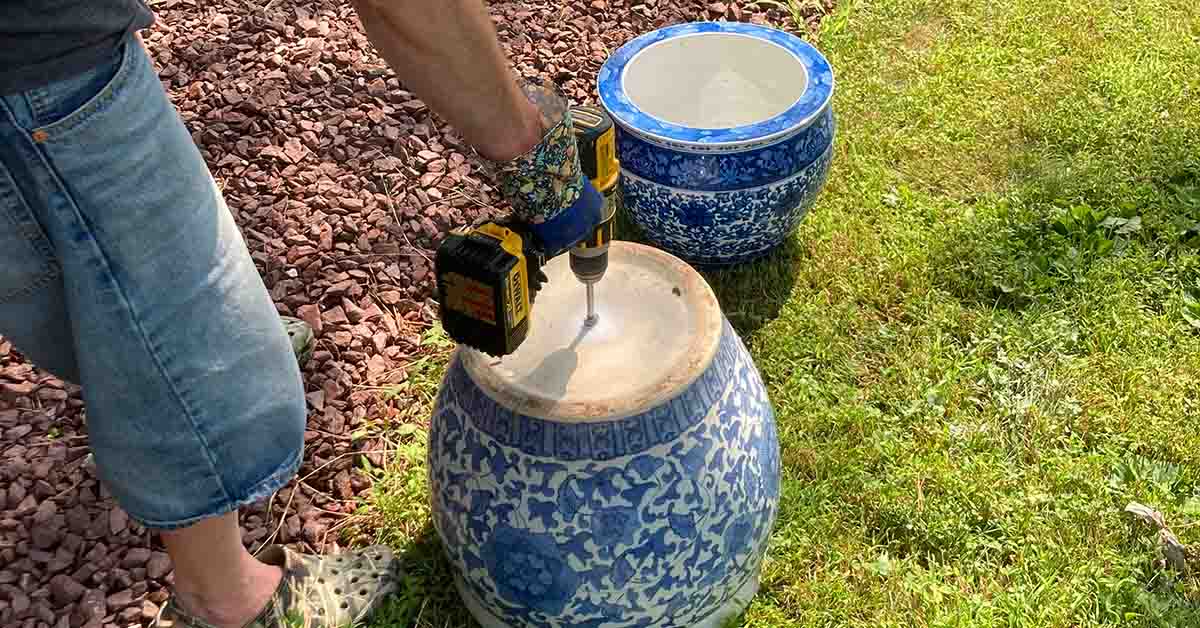
This can be done by using a drill bit meant for ceramic or porcelain. My husband was kind enough to create holes in a gorgeous blue and white Chinese planter last year. It looked amazing with red geraniums. If you do use a ceramic planter, store it in your garage over the winter to prevent freezing and cracks.
Photo: Terry Tunkel

I’d love to hear everyone else’s money saving tips for the garden!
Your affectionate friend,
Terry

Growing African Violets From a Single Leaf

Dear Reader,

I am partial to violets in my garden. There is something innocent, sweet, and old-fashioned about them; but I never had an indoor African Violet. I was under the impression that they were challenging to grow. They’re tropical plants from Tanzania and Kenya, endangered in the wild due to deforestation. I thought they needed more humidity than my forced hot air heating system could provide. One day I mentioned this to my mom, who has a natural green thumb, doctoring many sick plants back to health. We love talking about gardening and texting each other photos of beautiful blooms or an interesting new flower we found.  The next time I saw my mom she gave me two African Violets in a sweet, little basket tied with a gold bow. Those flowers are very meaningful to me as a symbol of my mother’s love. 

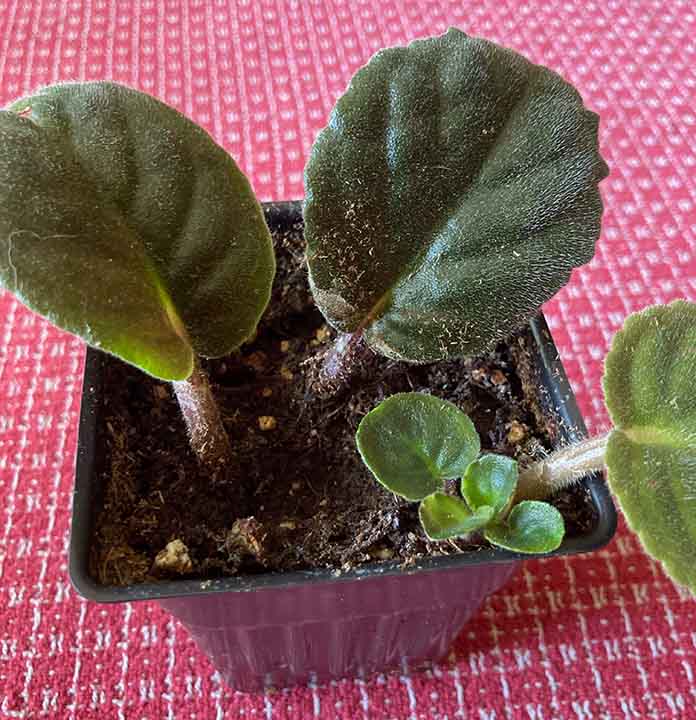
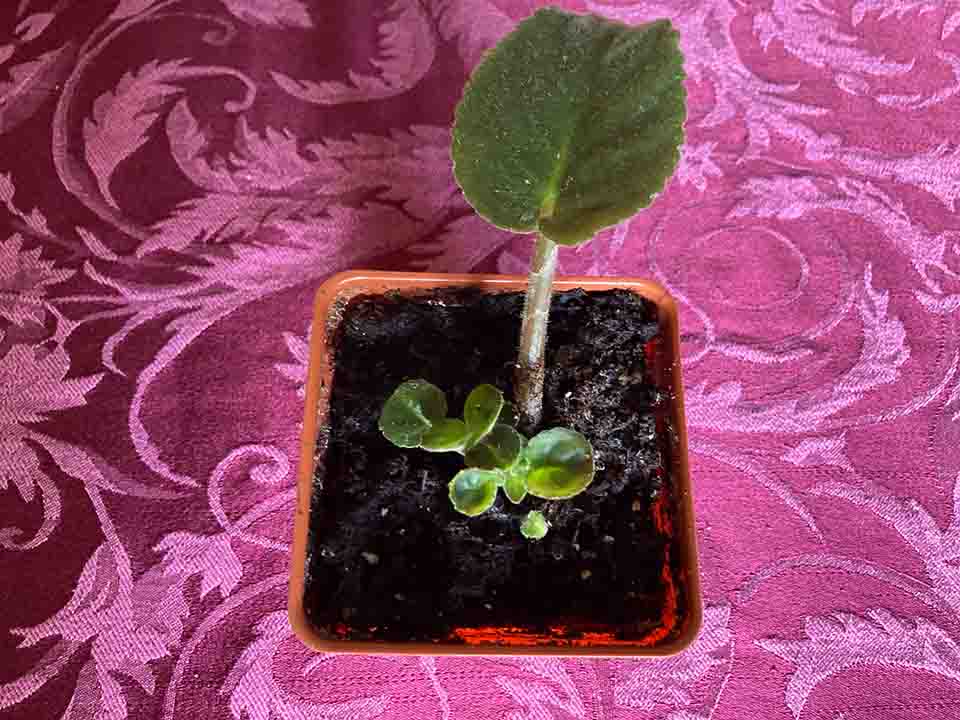
So I learned to care for African Violets and it's a lot easier than I had thought. I decided to propagate the ones my mom gave me.  As it turns out, this is pretty simple. You can purchase rooting hormone, potting soil and fertilizer made specifically for African violets. But I always like to go with the cheapest, easiest option. African violets will root in water, but it takes about a month. Simply find a healthy leaf on the parent plant and cut it off using a diagonal cut and put the stem into water.  Once the leaf baby has about an inch of roots you can plant it in a pot with drainage holes and potting mix. It is a little funny to see a single leaf sticking out of the soil. You can plant several leaves in one pot and separate them out several weeks later when you start to see tiny leaves poking up through the potting mix.

It’ll take about 6-8 months for the new plant to bloom. Try not to get water on the leaves as the leaf will “burn” and lose its emerald color. If a leaf does get wet, just pat it dry right away and it will be fine. You can bottom water them, or do like me and just be careful. I use a small watering can with a thin nozzle.
Photo: Terry Tunkel
Photo: Terry Tunkel
Proper light, water and fertilizer are the key to getting them to flower. Use room temperature water to keep the pot lightly wet and fertilize every couple of weeks. They like indirect light from a western or southern facing window.

African violets can last decades with simple care and repotting once a year. Time and patience is what is needed to raise these dainty flowers. In the language of flowers the violet has many meanings; but my favorite is that violets symbolize the faithfulness of mothers, and in Christianity, are associated with Mary. Thanks, Mom!

Your affectionate friend,
Terry

Nature at Heart

Sometimes, while playing in the yard, one of my boys would bring me a flower from the garden. I'd look closely to blow away any bugs and then tuck it behind my ear. At that time we lived in a home that had a beautiful flower ground cover surrounding the swing set. We would look down from the treehouse at the lavender sea and pretend we were pirates. Precious memories as my children developed a love of nature and the environment. Involving kids in nature and gardening engages all their senses to bring many benefits. Children learn cause and effect, science, environmental stewardship, and develop motor skills and self-confidence. Today’s post comes to us from Ruth Denys, from the Nature at Heart School in Bridgewater, NJ. Their mission is to "create opportunities to play, collaborate, wonder and persist through problem solving within our natural world.” Find out more, and register for classes at https://natureatheartschool.com/.

The summer weather brings 90° humid weather and cloudless skies. Days like today encourage us to take it slow.  “Let’s go into the woods!” shouts one of our nature seekers.  We escape the heat and find reprieve in the shaded forest.  The kids side-step down the rocky trail. By slowing down they begin to notice the little details all around them: shades of green, bark textures on trees, the sweet onion grass, and the tiniest little red ant on a mossy log.  They take out their magnifying glasses to get an even closer look. Small hands flip to a blank page in their log and begin to draw the ant’s journey in their nature journals.

We continue our walk along the trail with our journals in hand, and soak in all of the surrounding beauty.  Suddenly a child calls, “Come here, come here!”  What did we miss?  We look up through the filtered sunlight, patches of the beautiful sky peeking through and we notice a flitting color-momentary movement in the calm of the forest. Someone exclaims, “A butterfly!” All eyes turn to watch the dancing insect as it flits searching for more flowers.

Seizing the moment, we ask the children, “Why do you think the butterfly is going from flower to flower?” We discuss that butterflies eat nectar from the flowers and also spread pollen from flower to flower.  By doing this, the plants get pollinated and are able to make seeds from their flowers. Once again, small hands flip to a blank page in their nature journals and begin to draw curved lines for the flower shape and for butterfly wings. 

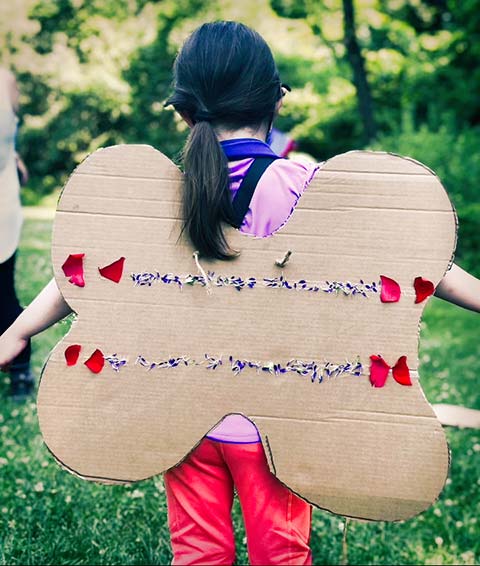
The butterfly’s swift movement mesmerizes us and fills us with the impulse to move our bodies in the same way.  The group makes its way out of the woods, gathering colorful pieces of nature along the way.  Later we will use these natural materials when we construct cardboard butterfly wings. Children's learning is reinforced by drawing and journaling about their experiences, but also by continuing to play and act out what they’ve observed.

Photo: Melissa Ferrao
Take your child on butterfly search. Encourage them to notice how they move and fly.  

Then together, practice soaring like butterflies with cardboard wings of your own.

Colorful Cardboard Butterfly Wings: 

P.S. Observing butterflies is one of many ways to engage your child in nature and gardening. You might have your child help you water, deadhead, design a rainbow themed garden, harvest veggies with a basket you’ve decorated, and so much more!